
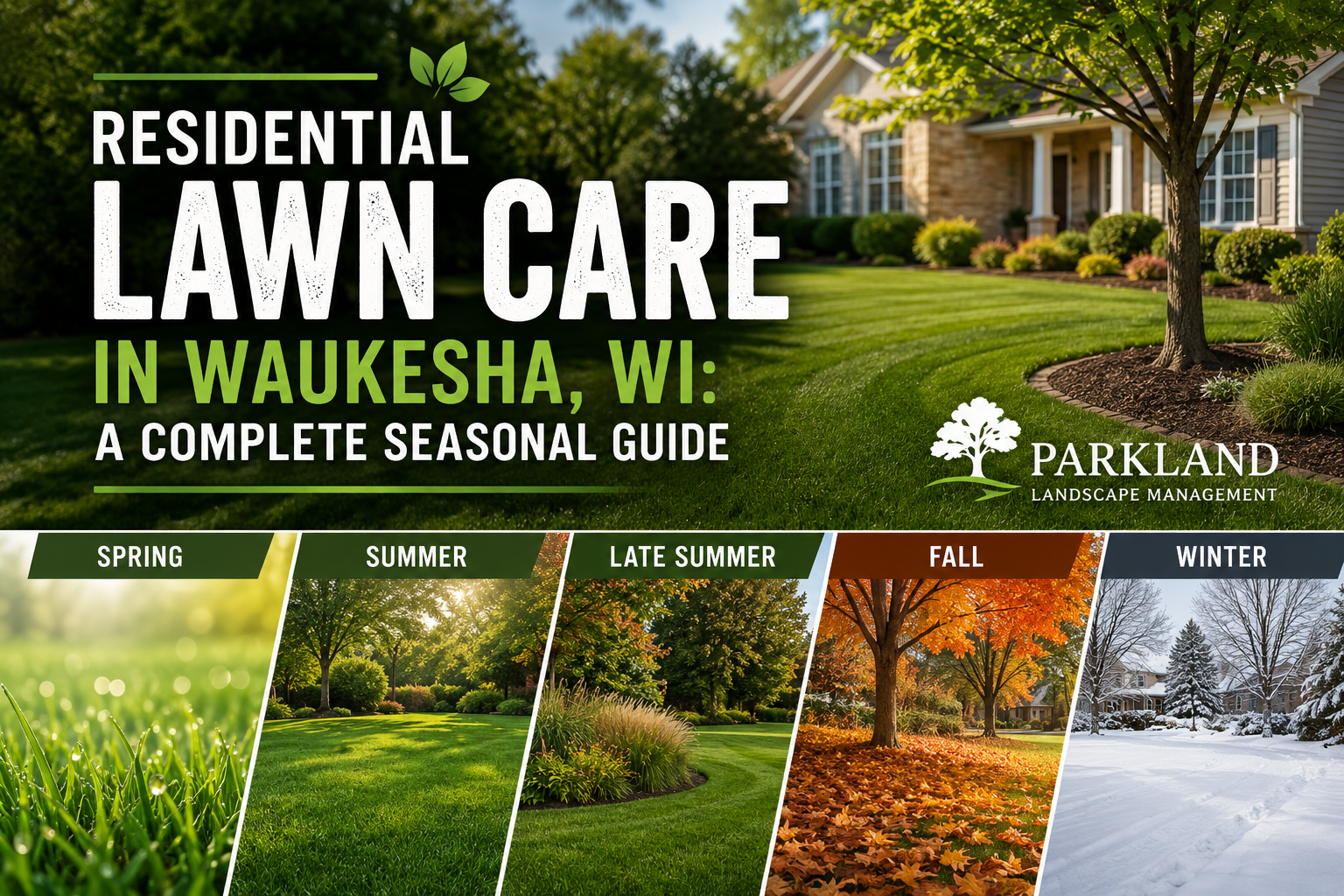
If you’ve lived in Waukesha County for more than a year or two, you already know Wisconsin doesn’t do “mild” seasons. We go from snow cover to mud to a few weeks of perfect green-up, then straight into humid summer stretches, and back down again — and your lawn feels every bit of that whiplash. It’s part of why so many homeowners here end up frustrated with residential lawn care in Waukesha, WI: they do “lawn stuff” in spring, forget about it by July, and then wonder every April why the crabgrass won.
Here’s the thing — most of that frustration comes down to timing, not effort. Cool-season grasses like the Kentucky bluegrass, ryegrass, and fescue blends common around here have a rhythm to them, and once you know it, lawn care stops feeling like guesswork. Below are the six steps that actually make up solid residential lawn care in Waukesha, WI, laid out the way we’d walk a customer through their own yard — season by season, so you can either follow it yourself or hand the whole thing off and stop thinking about it.
Why Timing Is the Real Secret to Residential Lawn Care in Waukesha, WI
We’re in USDA zone 5b, which basically means our grass wants to grow hard in spring and fall and coast through the summer heat. That matters because a lot of lawn products — crabgrass preventer especially — only work in a narrow window. Put it down too late and you’re not preventing anything, you’re just watching crabgrass grow through fertilizer you already paid for. So more than which product you use, when you use it is what actually separates a great lawn from a so-so one. That’s the foundation everything below is built on.
Step 1: April Pre-Emergent (Crabgrass Prevention)
This is the one date homeowners miss most often. Once soil temps climb into the low 50s for a few days running — usually early-to-mid April around here — it’s time to get a pre-emergent down. It works by blocking germination, so it has to go on before crabgrass sprouts. Wait until you can see it and you’ve already missed the window; at that point you’re managing it, not preventing it.
A few things to keep in mind this month:
- Pre-emergent plus a slow-release fertilizer is the standard combo — no need to treat them as separate steps
- Once your grass is hitting 3 to 3.5 inches, you can start mowing — just don’t take more than a third of the blade off at once
- Don’t panic if the lawn still looks a little rough in early April. It’s normal.
Step 2: May–June Broadleaf Weed Control
By the time everything else in the yard is blooming, so are your weeds. This is the window for targeted broadleaf weed control, and it’s genuinely satisfying — you can spot-treat problem areas or go broader if the whole yard needs it, and it won’t touch your turf.
While you’re at it, this is a good stretch to start a real mowing routine (weekly, generally), and if your yard tends to puddle or feels hard underfoot, late spring is a fine time for core aeration.
Step 3: Summer Maintenance (July–Mid-August)
Once it’s consistently pushing past 85 degrees, your grass basically shifts into survival mode — cool-season lawns just don’t want to grow much in real heat, no matter what you feed them. So this stretch of residential lawn care in Waukesha, WI is less about pushing growth and more about not undoing your spring work.
A slow-release organic fertilizer keeps color and root strength up without forcing top growth you don’t need in the heat. If weeds pop back up, spot-spray them rather than doing a full reapplication — no reason to treat the whole lawn for a few stragglers.
On watering: deep and infrequent beats daily and shallow, every time. You’re aiming for something like an inch to an inch and a half a week, rain included. And if you can, bump your mower height up a notch during the hottest weeks — taller grass shades its own roots and holds moisture better. Try not to mow during a drought stretch or in the middle of a 90-degree afternoon; the grass doesn’t need that stress on top of everything else.
Step 4: Late Summer Weed Control and Overseeding (Mid-August–Mid-September)
Weeds tend to make a second push once temperatures start easing off, so this is round two of broadleaf control — cleaning up anything that came back or showed up new since early summer.
It’s a good stretch for trimming back shrubs and hedges too, while you’re already out working on the yard. It’s also honestly one of the best times of year to overseed thin or bare spots — the soil’s still warm, the air’s cooling down, and that combination is close to ideal for germination. Keep an eye out for grubs while you’re at it: spongy, browning patches that don’t respond to water are the usual tell, and late summer is when they tend to show up.
Step 5: Fall Winterizing (Mid-September–October)
If someone told me they could only do one round of lawn care all year, I’d tell them to do it in fall. Cool nights and soil that’s still holding some warmth are when grass builds root mass better than at any other point in the year. What you do now genuinely determines how the lawn comes out of winter — this step alone carries more weight than any other part of a residential lawn care in Waukesha, WI program.
The winterizer application is built to feed the roots rather than push leaf growth, so the lawn goes into dormancy with reserves built up instead of running on empty. It’s also worth doing one last spot-spray on any lingering weeds before they go dormant too.
Beyond that: if you haven’t aerated this year, fall is arguably the better window than spring, since it lines up right before the strongest root-growth stretch. Keep mowing until growth actually stops, and drop your final cut slightly lower than usual to help prevent matting under snow. And don’t sleep on leaf cleanup — a wet, matted layer of leaves left over winter can genuinely smother and kill the grass underneath it.
Step 6: Winter Dormancy (November–March)
Dormant doesn’t mean forget about it entirely. Stay off frozen or frost-covered grass if you can — walking on it damages the blades even though it’s not actively growing. Keep an eye on drainage too; meltwater that pools and refreezes can suffocate turf or cause real ice damage in low spots. Otherwise, winter’s your planning season — a good time to think about whether you want to reseed a rough patch, redo a bed, or just tighten up your program for next year.
Quick Reference: The Full Residential Lawn Care Waukesha WI Calendar
| Step | Season | Key Task |
|---|---|---|
| 1 | April | Pre-emergent + slow-release fertilizer |
| 2 | May–June | Broadleaf weed control, start regular mowing |
| 3 | July–mid-Aug | Organic fertilizer, spot-spray as needed, deep watering |
| 4 | Mid-Aug–mid-Sept | Second weed control round, overseeding |
| 5 | Mid-Sept–Oct | Winterizer, fall aeration, leaf cleanup |
| 6 | Nov–March | Dormant — drainage checks, planning ahead |
Or, Just Let Us Run This For You
Honestly, this is close to word-for-word the schedule we already run for clients across Waukesha and Milwaukee County — same timing, same steps, same attention to what the soil and weather are actually doing instead of just going by the calendar. If you’d rather not manage residential lawn care in Waukesha, WI yourself, get a free quote and we’ll take it off your hands.
Parkland Landscape Management has served Waukesha and Milwaukee County since 1994 — locally owned, family run, and still doing this the same hands-on way three decades in.